
Does Anything Reliably Open the Spotify App From a Meta Ad? An Honest Answer
A musician asked if ANY solution reliably opens the Spotify app on both iPhone and Android from inside the Meta in-app browser. The honest answer is no — here is what actually works, how well, and what it costs you in attribution.
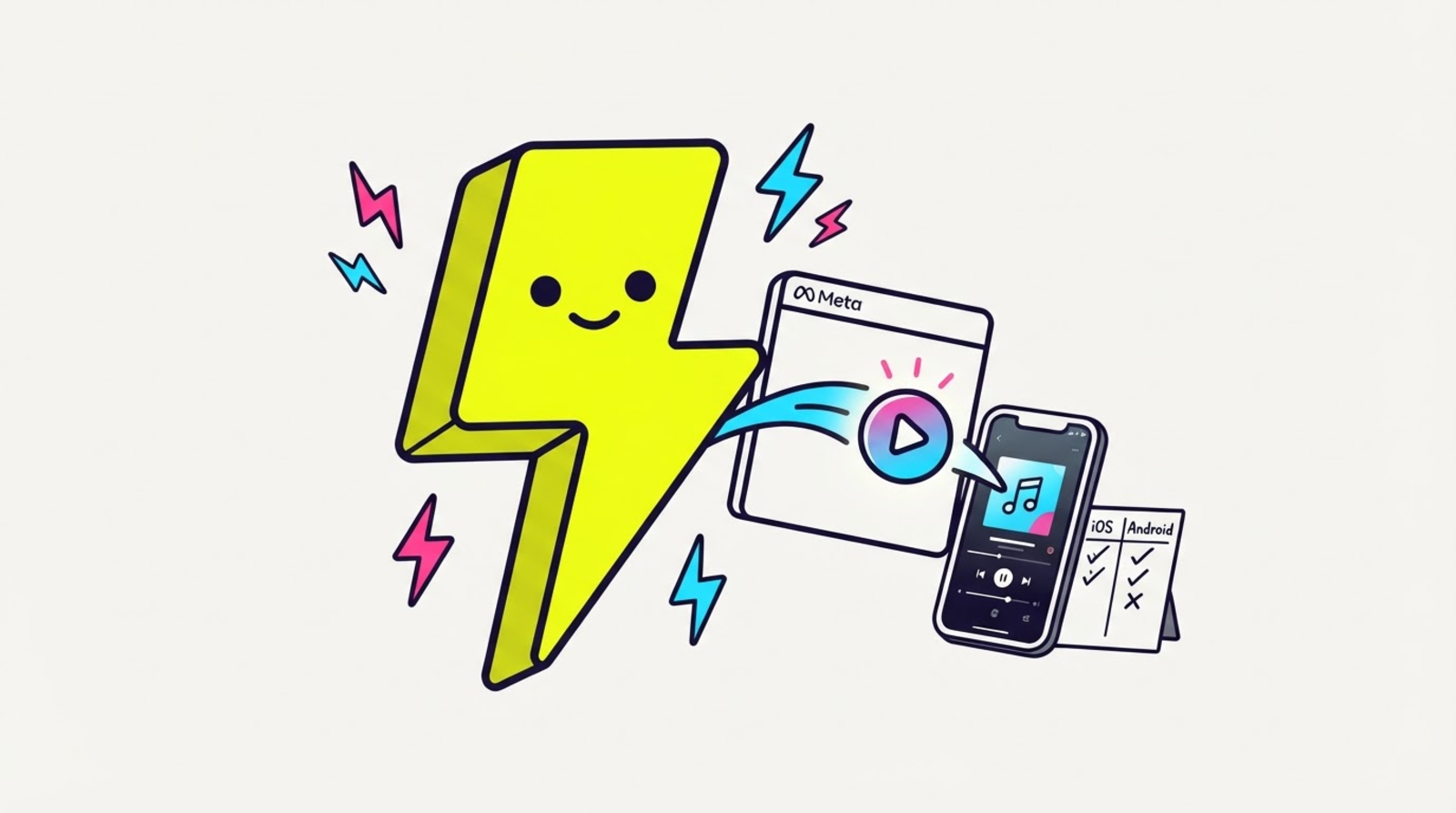

⚡ Zippy: short version — no. nothing is reliable on both. here's exactly how close you can get, and what it costs.
In May 2026, a musician on r/musicmarketing posted the cleanest statement of this problem anyone has written:
"I'm using a Hypeddit landing page, but when people click through to Spotify, the link opens inside the Meta in-app browser instead of the actual Spotify app. So users land on Spotify web, not logged in, and conversion basically dies there."
"Is there currently ANY working solution that reliably opens the Spotify app directly on both iPhone and Android?"
— u/EmilyVibezNextDoor, Meta browser kills my spotify ads, r/musicmarketing, 2026-05-10
Four months earlier, a different musician had named the thing in a post title — How to fix the "In-App Browser Trap" for Meta Ads on a budget? — and added the part every vendor page leaves out: "I've noticed this behavior is inconsistent — sometimes it works, sometimes it doesn't."
This post is the answer to that question, written to be useful whether or not you ever pay us a cent. We build one of the tools in this category, so read the competitor section with that in mind — we have tried to make it the section a competitor would agree with.
The honest answer, up front: there is no method that reliably opens the Spotify app on both iOS and Android from inside the Meta in-app browser. There is a method that works most of the time on iOS, less often on Android, and degrades to a tappable button instead of a dead end. That is the ceiling, and every paid tool in this space is selling you that same ceiling.
Why the Meta in-app browser eats the handoff
Three separate mechanisms have to fail for your ad to die, and all three do.
1. The webview is a different browser with a different memory. When someone taps a link in an Instagram or Facebook ad, the page does not open in Safari or Chrome. It opens in a browser Meta ships inside its own app — WKWebView on iOS, android.webkit.WebView on Android. That browser has its own cookie jar and its own local storage, isolated from the real browser and from every other app. Whatever Spotify session lives in Safari or in the Spotify app is invisible to it. We wrote up the anatomy of that sandbox in why links die in the in-app browser.
2. So the visitor is a logged-out stranger. Spotify web, logged out, gives you a 30-second preview and a signup wall. It does not give you a save, a follow, a library add, or a full play. The user was signed in the whole time — in the Spotify app, on the same phone, one home-screen tap away. The webview simply cannot see it. That is the entire conversion loss, and it is why "the click worked" and "the campaign worked" are two different sentences. More on the logged-out half in the logged-out webview problem.
3. And the escape hatch you'd expect is disabled by design. This is the part people get wrong, so it gets its own section.
Why universal links don't save you
An Apple universal link is the mechanism that makes https://open.spotify.com/track/... open the Spotify app when you tap it in Messages or Mail. It works because iOS checks the domain's apple-app-site-association file and routes the tap to the app instead of the browser.
A universal link does not fire from inside a WKWebView. That is not a bug and not Meta being hostile — it is documented iOS behaviour. A webview navigating to a URL is not a "tap on a link" in the sense universal links respond to. The webview just… loads the page. Which is exactly what you are watching happen.
Android has the same shape of problem with App Links: verified https links open the app when the system routes them, but a WebView navigating to a URL routes it to itself.
So the thing that works everywhere else on the phone is specifically switched off in the one place your paid traffic lands.
What you've already tried, and precisely when each one works
This is the section the musician actually asked for. Each of these does work — somewhere. None of them works here.
| What you tried | When it works | Why it fails in the Meta browser |
|---|---|---|
spotify:track:... URI as the ad destination | Tapped from a native surface that hands schemes to the OS — a notes app, a native list, a QR scanner | Meta ads require an http(s) destination. You cannot set a spotify: URI as an ad URL at all, and in a bio it usually renders as unclickable text |
https://open.spotify.com/... (universal link) | Messages, Mail, a real browser, most native apps | Universal links do not fire from inside a webview. The webview loads Spotify web itself. This is the single most common "why isn't this working" |
Adding ?si=... | Nothing, for routing | ?si= is Spotify's share token — an attribution parameter for Spotify's own reporting. It has no effect on whether an app opens. Chasing it is chasing a red herring |
| A Hypeddit / SubmitHub / smart-link landing page | Often — these pages do run a scheme launch in JavaScript | The final hop is usually still a universal link, and the page itself is loaded inside the webview. Behaviour varies by vendor, by OS version, and by month. This is the "sometimes it works, sometimes it doesn't" everyone reports |
| Telling people to "open in browser" from the ⋯ menu | Always, mechanically | You are asking a stranger who came for a song to perform a three-tap workaround. A small single-digit fraction will. Another Redditor in that thread, u/mr_taco2, reported the same collapse through a SubmitHub page: "Same thing happened, submithub landing page. Ad dies at landing page" |
One more that comes up: iOS remembers when a user dismisses an app-open prompt. If someone once chose "browser" on a Spotify smart banner, iOS can keep honouring that choice for that domain. Some of the inconsistency people report is not the tool being flaky — it is per-user state you cannot see or reset.
The one technique that actually does something
Every tool in this category — ours included — does the same thing, and it is worth understanding because it explains both why it works and why it can never be perfect.
You give the ad an ordinary https:// destination, which the webview is perfectly happy to load. That page is not the destination. It is a tiny page whose only job is to run one line of JavaScript that navigates to a custom scheme URI — spotify://... on iOS, or an intent:// URL on Android.
The webview will not follow a universal link. It will hand a custom scheme to the operating system. So the escape is performed from inside the trap, by a page the trap agreed to load.
That's it. That's the whole trick. It is not proprietary, it is not novel, and anyone reading this could implement it in an afternoon. URLgenius does it, Feature.fm and Linkfire do a version of it, the smart-link pages do a version of it, and we do it. Nobody in this category has a secret.
What it can't do: it cannot force anything. The OS may decline. The host app may suppress a navigation that wasn't triggered by a finger. The app may not be installed. The correct behaviour when it fails is a visible button the user can tap — because a gesture often succeeds where an automatic navigation was blocked — and never a silent dead end.
iOS and Android are not the same story, and Android is worse
The person who asked this question asked about "both iPhone and Android" for a reason. The gap is real and it is large.
On iOS, WKWebView will generally hand a custom scheme to the system. The app switch happens fast, and the main failure modes are: the app isn't installed, or Meta has decided to suppress that particular navigation. Both degrade to "the page is still sitting there," which is why the fallback button matters.
On Android, it's messier:
- The standard mechanism is an
intent://URL with aS.browser_fallback_urlparameter. That gives you a genuinely nice property: if the app isn't there, the browser goes to your web URL instead of erroring. - But
intent://handling is a Chrome feature, not a WebView feature. Meta's Android in-app browser is WebView-based. Whether it parses anintent://URL the way Chrome does is inconsistent across app versions and OEM builds, and it is not something any vendor can promise you. - Android fragmentation compounds it: manufacturer skins, custom default-app handling, and battery-optimisation behaviour all get a vote.
The only public number we have seen from someone measuring this in the wild came from that same Reddit thread — a user of a competing tool, describing their own dashboard:
"I use URL Genius, which works well and shows what percentage of users made it to the app. iOS is usually around 100%, but unfortunately you won't like the Android number. Typical hovers between 30 and 40%."
— u/newbathroomtime, r/musicmarketing, 2026-05-10
That is someone else's measurement of someone else's product, and we are quoting it as exactly that. We have not reproduced it, it is not a benchmark, and one user's dashboard is not the industry. But it matches the mechanism above, and it is the most useful single data point in public. Treat it as a shape, not a figure: iOS good, Android substantially worse.
If you are planning a campaign around this, plan for your Android half to underperform your iOS half, and segment your reporting by OS so you can see it. That advice costs nothing and doesn't require buying anything.
The tradeoff nobody selling this will tell you: your pixel gets worse
Here is the finding that cuts against everyone in this business, including us.
When you successfully send someone into the native Spotify app, they leave the measurable surface. The webview was the only place your Meta pixel could see them. The moment the app switch succeeds, the pixel's session ends and everything that happens next — the play, the follow, the save, the playlist add — happens somewhere no browser tag can reach.
So the fix makes your Ads Manager numbers worse while making your actual results better. This is not hypothetical. The same musician who opened this thread came back three days later:
"I changed my landing page now from hypeddit to submithub. - now it seems to work. The link opens the app!!! But although I added my metapixel to the submithub landing page i get no conversions in my meta add manager but the followers of my playlist are increasing. All in all it's an improvement"
— u/EmilyVibezNextDoor, r/musicmarketing, 2026-05-13
Zero reported conversions. Rising real followers. She trusted the real one, and she was right to — but notice what that does to a campaign you are optimising with Meta's own bidding. If Meta can't see the conversion, Meta can't optimise toward it, and your CPA report becomes a measurement of the wrong thing.
Practical consequences, stated plainly:
- Expect reported conversions to drop when you start winning the app switch. Do not read that as the change failing.
- Your ground truth moves to Spotify for Artists — listeners, saves, playlist adds, and the ad-attributed breakdowns Spotify surfaces there — plus the raw click volume from your link tool. Compare those to your ad spend by hand for a couple of weeks before you trust anything.
- Optimising a Meta campaign for a conversion event that the fix makes invisible is a trap. Consider optimising for link clicks or landing-page views and judging outcomes outside Ads Manager.
And the skeptic in that thread might be right
We are including this because leaving it out would be dishonest, not because it helps us.
A commenter in the same thread pushed back on the whole framing:
"Just because it doesn't track, does not necessarily mean that they didn't go through to the app, or find you manually on the app, and listen!"
— u/PaulNichollsMusic, r/musicmarketing, 2026-05-10
And a merchant in a parallel r/shopifyDev thread about the same webview problem responded to it with: "I would hazard a guess it's an incorrectly setup pixel?"
Both objections are fair and neither is fully answerable. Some fraction of the "lost" traffic was never lost — people closed the webview, opened Spotify themselves, and listened. That listen is real revenue that no tracking system in this stack attributes to your ad. Which means:
- The size of the leak is genuinely uncertain, and anyone quoting you a precise loss figure is guessing.
- Some of the gain a deep-link tool reports is a measurement gain (you can now see people you always had) rather than a revenue gain.
- Pixel misconfiguration is a real and common alternative explanation. Rule it out before you conclude the webview is your problem: check that the pixel fires at all in a webview session, and check whether your reported drop-off is OS-correlated. If iOS and Android look identical, the webview is probably not your main issue.
The honest position is that the mechanism above is definitely real, and its dollar value to your specific campaign is not something anyone — us, URLgenius, Linkfire — can currently prove to you. A paying customer of a market-leading deep-link tool said as much in a different thread: he had used it for a year and "it is really hard to prove if higher conversion is because of deep linking or not."
What the tools actually do, and how they differ
They all use the technique in the section above. The differences that matter are pricing, measurement, and what happens when it fails.
- URLgenius — does the same scheme launch, and importantly reports the percentage of users who made it to the app, which is the feature that made the problem legible for the Redditor quoted above. Anyone telling you they are the only ones measuring app opens is wrong; URLgenius has been showing that number to customers for a while. Its pricing is per-click, which is what people in these threads object to — the more the campaign works, the more it costs. Our long-form comparison is at Zippy vs URLgenius, and it has an obvious bias; read it as a competitor document.
- Feature.fm / Linkfire — the music-industry incumbents, named by the musician who coined "In-App Browser Trap" as the tools he believed solved it. Built for release campaigns with pre-saves and multi-service landing pages. More product than you need if you only want the app to open; less blunt than you'd like about the ceiling.
- Hypeddit / SubmitHub — landing-page tools first, routing second. This is where several people in these threads started, and where two of them found the failure. Note that one of them then found SubmitHub did work for her, which tells you the variance here is real.
- Zippy (us) — same technique, open source, flat price. Details and limitations below.
The stated budget in that r/musicmarketing thread was "without spending $20/month on a link service." That is a real number from a real buyer, and it's worth knowing that free options exist in this category: several deep-link tools have free tiers, and if you can host a static page you can implement the scheme launch yourself in about twenty lines of JavaScript. You do not need us to solve this. You may just want the measurement, which is the honest reason to pay anyone in this space.
What Zippy does, and exactly where it doesn't work
Since you'd reasonably want to know before trusting anything above.
What it does. You point a Zippy link at an open.spotify.com URL. When a mobile visitor taps it, Zippy serves a small page that fires spotify:// on iOS or an intent:// URL on Android.
On iOS that page then stays put: it shows an "Open in the spotify app" button as a gesture retry plus a "Continue in browser" link, and never auto-redirects on failure, so a slow cold start that lands three seconds later still counts and still works.
On Android it does none of that, and you should know it before you buy anything. Our page fires the intent:// URL and returns immediately — the visitor never sees the page, gets no button, and gets no "the app didn't open" copy. And the intent:// URL carries browser_fallback_url, which navigates to your web URL by itself when Spotify isn't there. So on Android we do silently bounce to logged-out Spotify web, which is the failure this whole post is about. That's our bug, not a design choice, and it's the same early return that breaks our Android measurement below. The redirect itself is free forever on every plan, including the free one, and the engine is open source so you can read the escape logic rather than take our word for it.
Where it doesn't work — please read this part:
- Only if the link points directly at Spotify. Zippy matches on the destination host. A Zippy link pointed at
hypeddit.com/...or a SubmitHub page is just a redirect — the landing page loads in the webview and the trap is fully intact. To get the escape you have to drop the landing page from the chain and point the link atopen.spotify.com. That is a real change to how you run campaigns, and per the thread above, it is also the change that made one musician's Meta pixel report zero conversions. - Tracks, albums, artists and playlists only. Spotify podcast episodes and shows, and
spotify.linkshort codes, currently route to the Spotify app's home screen rather than to your content. That's a hole in our implementation, not a feature — use a fullopen.spotify.com/track|album|artist|playlist/...URL until we close it. - Spotify and Apple Music are the music services we support. A
music.youtube.comlink currently opens the YouTube app rather than YouTube Music. SoundCloud, Bandcamp, Tidal, Deezer and Amazon Music get a plain redirect with no app escape at all. - We do not defeat Meta. If Meta suppresses the scheme navigation on iOS, we degrade to a button someone has to tap. Better than a dead end. Not a fix. On Android there is no button to degrade to — see above.
- The
?si=share token is dropped on the app-open paths, because we read the content ID out of the URL path.
How our app-open number is measured, and how it can lie to you
Zippy reports an app-open rate. Here is exactly what that number is, because "we measure app opens" is a sentence that hides a lot.
It is an inference from our own page's visibility, not a report from Spotify. Our page fires the scheme and then watches itself:
- If the browser tells us the page became hidden, we record
opened— the reasoning being that the page went away because another app came to the front. - If the page is still visible after our long stop of nine seconds, we record
browser.
Nothing in that loop is a receipt from Spotify. Spotify never tells us anything. The failure modes follow directly:
- A phone lock, an incoming call, or a notification tap inside that window hides the page and reads as opened. False positive.
- A cold start slower than nine seconds leaves the page visible and reads as browser, even though the app opened a moment later. False negative — rarer than the phone-lock false positive, because nine seconds is a long time for a cold start.
- We cannot tell "our page launched the app" from "the user backgrounded to Spotify on their own" — which is exactly u/PaulNichollsMusic's objection above, and we do not have an answer to it.
- The underlying analytics store samples, so small numbers are noisier than they look.
Therefore: it is a rate and a trend, never per-click truth. It is useful for "did this change help?" and useless for "did this person open the app?" We say so on the app-open receipt itself for the same reason we're saying it here.
And we currently do not publish an Android app-open rate at all. Our Android measurement path doesn't reliably record failures the way the iOS one does, which means an Android figure from us today would be biased high — flattering and wrong. Given that Android is the platform everyone's numbers are worst on, publishing a flattering broken number would be the single most misleading thing we could do. We'd rather show you nothing until it's fixed. If you see an Android app-open rate from any vendor, ask them how failures are recorded, because that's where the bias lives.
So: what should a musician actually do on Monday?
A checklist that costs nothing and doesn't require our product:
- Take the landing page out of the chain if the landing page's only job is to be a middleman. Point the ad at a link that goes straight to
open.spotify.com/track/.... Fewer hops, fewer places to lose the handoff. - Use a tool that fires the scheme from an https interstitial — ours, URLgenius, Linkfire, or twenty lines of your own JavaScript on a page you host. They're the same mechanism; pick on price and measurement.
- Insist on a fallback button. If the escape fails and the visitor is stranded on a blank page, you've made things worse than a plain link.
- Split every report by OS. If you don't separate iOS from Android you will average a working platform with a struggling one and learn nothing.
- Move your ground truth to Spotify for Artists, and expect Ads Manager conversions to fall as the fix starts working. Watch saves, follows and playlist adds against spend.
- Before blaming the webview, verify your pixel. The skeptics in those threads are sometimes right, and it's a free thing to rule out.
- Test on a real Android phone, inside the real Instagram app. Not desktop, not a simulator, not iOS-only. That is where this breaks, so that is where you check it.
⚡ Zippy: the trap is real. the fix is partial. anyone selling you certainty on Android is selling you something.
The gist
There is no method that reliably opens the Spotify app on both iPhone and Android from a Meta ad. The best available technique — an https interstitial that fires a custom scheme from inside the webview — works well on iOS, inconsistently on Android, and needs a visible fallback button when it doesn't. Every paid tool in this category sells that same technique; they differ on price, on measurement, and on honesty. And escaping the webview will make your pixel report worse even as your real results improve, so move your ground truth to Spotify for Artists before you change anything.
Background reading, none of it a pitch: the in-app browser problem, why links die in the in-app browser, and why your tracking pixel breaks in there — which is the browser-side half of the attribution story this post completes.
If you want the version we build, it's free to try and the routing is free forever: start zipping →
FAQ
Why do my Spotify links open in the Meta in-app browser instead of the Spotify app?
Instagram and Facebook open every tapped link inside their own webview rather than handing it to Safari or Chrome. A Spotify universal link cannot escape a webview — by Apple's design, a universal link tapped inside a webview navigates in place instead of launching the app. So the listener lands on Spotify web, where they are almost never signed in, and gets a 30-second preview with no way to save or follow.
Does a smart link actually fix the in-app browser trap?
Partly, and it is worth knowing exactly how far. A smart link serves an https page the webview will happily load, and that page's JavaScript fires Spotify's own URL scheme from inside the webview — something a universal link cannot do. That is a real mechanical difference from what you have already tried. It is not a guaranteed escape: Meta can suppress a scheme launch that wasn't started by a tap, which is why Zippy renders a tap-to-open button on iOS as well. On Android there is no such button today — our page fires the intent:// URL and returns immediately, and the intent falls back to Spotify web on its own; that is a bug we own. There is no tool that escapes the Meta browser 100% of the time, ours included.
Is Zippy the only tool that shows the app-open percentage?
No. URL Genius shows an app-arrival percentage too, and a musician recommended it publicly in the same thread this post quotes. The app-open number is not our invention and we do not claim it is. What we offer alongside it is an open-source redirect engine (AGPL), flat pricing rather than per-click, and an explicit account of how the number is produced and where it is wrong.
Will fixing the in-app browser improve my Meta pixel conversions?
Probably the opposite, at least at first. A listener who lands in the real Spotify app has left the webview your pixel lives in, so they disappear from Ads Manager. One musician in r/musicmarketing reported exactly this: after the deep link started working, her Ads Manager conversions read zero while her playlist followers rose. If you fix the handoff, expect reported conversions to drop and real outcomes to rise. Judge the change on Spotify for Artists, not on Ads Manager.
Is the Android app-open rate worse than iOS?
Yes. A musician using URL Genius reported iOS around 100% and Android typically 30 to 40%. Zippy publishes only an iOS app-open rate and no Android figure at all: our Android interstitial fires the intent:// URL and returns before it can record a failure, so an Android number from us would be biased high — flattering and wrong. We would rather show you nothing on Android than a number our own instrument inflates.
Do I point the link at Hypeddit or SubmitHub, or straight at Spotify?
Straight at Spotify. Zippy only deep links destinations it recognises, so a Zippy link pointed at a Hypeddit or SubmitHub landing page is a plain redirect and the trap stays fully intact. To get the escape, your ad destination has to be the Zippy link and the link's destination has to be the open.spotify.com URL. That means dropping the intermediate landing page, which is a real change to how you run the campaign, not a setting you toggle.